Last year I received an invite to attend the Paleoamerican Odyssey conference that was held last week in Santa Fe, New Mexico. I declined knowing that it would have been difficult to find the necessary funding for yet another trip across the ocean this year. However, my good friend and colleague Dr. Alessandro Achilli from the University of Perugia (Italy) was able to go and wrote me immediately after attending the presentation where these results were shared. Now I really wished I would have gone!
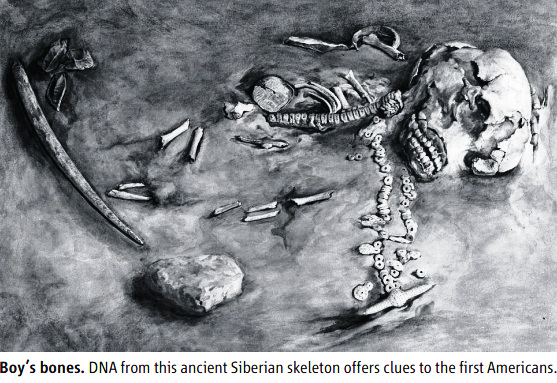
The study that will come out in the prestigious journal NATURE shortly (as of today it is in press), describes the genetic analysis of a 24,000 year old skeleton found in Siberia. The complete genome was sequenced, including the paternally inherited Y chromosome and the maternally inherited mitochondrial DNA. The results were not quite what was to be expected. The young boy DNA showed no relationship to Easter Asians, but 1/3 of the genome in common with Native American populations and the rest with Europeans. Even the Y chromosome and mitochondrial DNA look European as they belong to haplogroups R and U respectively. The report from SCIENCE included the following comment from the leading researcher:
"The finding suggests that about a third of the ancestry of today's Native Americans can be traced to western Eurasia, with the
other two-thirds coming from eastern Asia, according to a talk at [the meeting "Paleoamerican Odyssey" in Santa Fe, NM on 16–20 October 2013] by ancient DNA expert Eske Willerslev of the University of Copenhagen. It also implies that traces of European ancestry previously detected in modern Native Americans do not come solely from mixing with European colonists, as most scientists had assumed, but have much deeper roots."
It is obvious that these data and findings will have major implications with regard to our understanding of Native American origins and colonization events. Moreover, it opens a lot more questions on a topic that for so many was already closed. For sure, there is so much more to learn about how and when the ancestors of Native Americans arrived to the Western Hemisphere. Although the DNA in this particular study refers to a very ancient specimen, the presence of European DNA in the Americas that predates the arrival of Europeans within the last 500 years poses some serious new consideration with regard to be able to discern any sort of Old World DNA in the Americas from the time of the first arrivals all the way through the millennia to our days. Can European DNA found in modern and ancient Native Americans be immediately dismissed as being for sure post-Columbian? Can we discern European DNA introgression in the America's gene pool from 20,000 years ago, 10,000 years ago, 3,000 years ago, or 1,000 years ago?
Native American genetics got all of a sudden a lot more exciting! It will be interesting to see what the future will bring.
The study that will come out in the prestigious journal NATURE shortly (as of today it is in press), describes the genetic analysis of a 24,000 year old skeleton found in Siberia. The complete genome was sequenced, including the paternally inherited Y chromosome and the maternally inherited mitochondrial DNA. The results were not quite what was to be expected. The young boy DNA showed no relationship to Easter Asians, but 1/3 of the genome in common with Native American populations and the rest with Europeans. Even the Y chromosome and mitochondrial DNA look European as they belong to haplogroups R and U respectively. The report from SCIENCE included the following comment from the leading researcher:
"The finding suggests that about a third of the ancestry of today's Native Americans can be traced to western Eurasia, with the
other two-thirds coming from eastern Asia, according to a talk at [the meeting "Paleoamerican Odyssey" in Santa Fe, NM on 16–20 October 2013] by ancient DNA expert Eske Willerslev of the University of Copenhagen. It also implies that traces of European ancestry previously detected in modern Native Americans do not come solely from mixing with European colonists, as most scientists had assumed, but have much deeper roots."
It is obvious that these data and findings will have major implications with regard to our understanding of Native American origins and colonization events. Moreover, it opens a lot more questions on a topic that for so many was already closed. For sure, there is so much more to learn about how and when the ancestors of Native Americans arrived to the Western Hemisphere. Although the DNA in this particular study refers to a very ancient specimen, the presence of European DNA in the Americas that predates the arrival of Europeans within the last 500 years poses some serious new consideration with regard to be able to discern any sort of Old World DNA in the Americas from the time of the first arrivals all the way through the millennia to our days. Can European DNA found in modern and ancient Native Americans be immediately dismissed as being for sure post-Columbian? Can we discern European DNA introgression in the America's gene pool from 20,000 years ago, 10,000 years ago, 3,000 years ago, or 1,000 years ago?
Native American genetics got all of a sudden a lot more exciting! It will be interesting to see what the future will bring.

 RSS Feed
